

Geezer Teasers
Yesterday's heroes, tomorrow's hopefuls

When I saw the 1970s version of Superman long ago, I noticed that the poster had just one actor: Marlon Brando, who played Superman’s father Jor-El.
How long was Brando in the movie? Eight minutes. For a paycheck of $19 million, $2.4 million per minute. (As a guest later told Letterman, Brando “hated working but loved money” and “took the check and ran”).
“Half a million per ponderous, shouted cliche” - Roger Ebert
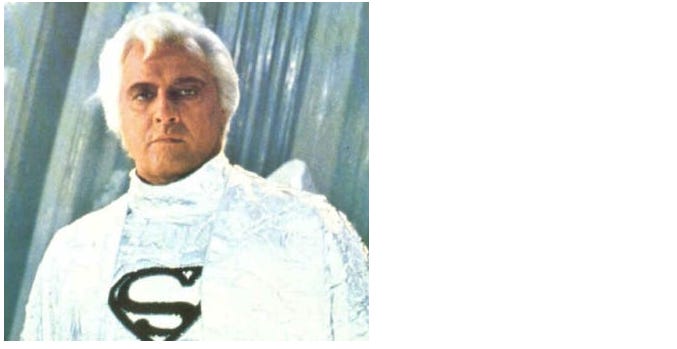
But for all his laziness, Brando gave the movie gravity. Without his cameo, we would never have met the real Superman - an unknown kid named Christopher Reeve who lit up the screen.
The geezer teaser formula
Superman wasn’t the first geezer teaser - where money is thrown at an aging big-name actor with barely any screen time - but it did bring the practice into blockbuster territory. The model was perfected when direct-to-video and streaming outlets created endless demand for “product” with built-in promotional power from recognizable names.
It works like this: The star is flown to a cheap overseas location. He gets a few million dollars for spending a day reciting lines fed through an earpiece. Scraps of footage are carefully spliced into the movie while no-name actors carry the story.
Yes, the star is technically in the movie. He’s like the sprig of parsley on a dinner plate - there for show, not sustenance.
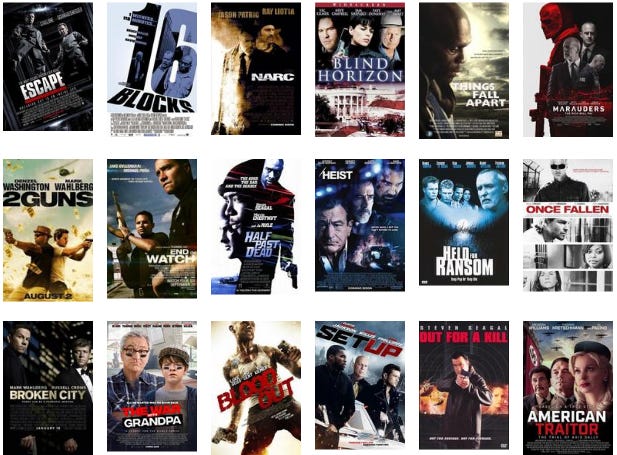
The geezer’s true value? His name. He's Bruce Willis, Mel Gibson, John Travolta, Nick Cage, John Malkovich, maybe even Schwarzenegger or Neeson. They’re not proud of their cameos, but we can only envy their hourly rate.
It’s classic bait-and-switch, a shiny object that catches your eye and triggers an impulse buy. The template is everywhere - especially when you expand the definition of “geezer” to “celebrity known for past achievements.”
You can apply the model anywhere
The Masterclass teaser. Want to learn hoops from Steph Curry, acting from Samuel L. Jackson, storytelling from Malcolm Gladwell or tennis from Serena Williams? That’s the promise of Masterclass: Your idol reveals the secrets that led to greatness.
The star drops in and reads from a prepared script. Steph sinks a three; Malcolm reads from The Tipping Point. The rest is ghostwritten, crafted by producers or educators. The name gives a whiff of authenticity and expertise, but it's mostly packaging.
I fell for it, buying a Michael Lewis storytelling course. He’s a charming guy who tells a good story. But there was nothing I couldn’t have picked up by reading Moneyball or The Blind Side.
The executive producer teaser. Executive producers - Oprah, Spielberg, J.J. Abrams, LeBron - get screen credit for the equivalent of reading lines from a teleprompter. Or less: Approve a pitch deck. Read a script (maybe). Make a few phone calls. David Mamet says the executive producer is “the guy who knows the guy with the money.”
Their real job is to lend their name and prestige to a project. The name is the sizzle; someone else cooks the steak.
Conan O’Brien’s hip-hop career. Last year Conan joined the Norwegian duo E.D.A. to recite a verse in the rap single “Velkommen til Klubben” (“Welcome to the Party”). He was filmed on green screen and spliced into the video with just enough presence to slap “Conan O’Brien” onto the title.
His name drove attention, headlines and streaming traffic. The real work (writing, production, performance and promotion) was handled by no-name locals. Geezer teaser in music form, with Conan as brand bait. His role: Feed the algorithm.
Romance among the zombies. In Seth Grahame-Smith’s genre-bender, Elizabeth Bennett is a master of Chinese martial arts and the proud, aloof Darcy is a ruthless zombie slayer. Pride and Prejudice and Zombies contains scraps of new text but leaves 95% of Jane Austen's original unchanged. Tweak the story with a few new events, extra dialogue and a contemporary point of view, and presto: A literary geezer teaser
Bruce the shark. An edge case is the movie Jaws - edge because Scheider, Dreyfuss and Shaw were established actors, if not A-listers. But the true star of Jaws was the Bruce the shark, who appeared on-screen for four out of 128 minutes. Bruce was hidden for the same reasons you might hide a bloated, dissipated action star: He was expensive, unreliable, and needed constant attention.
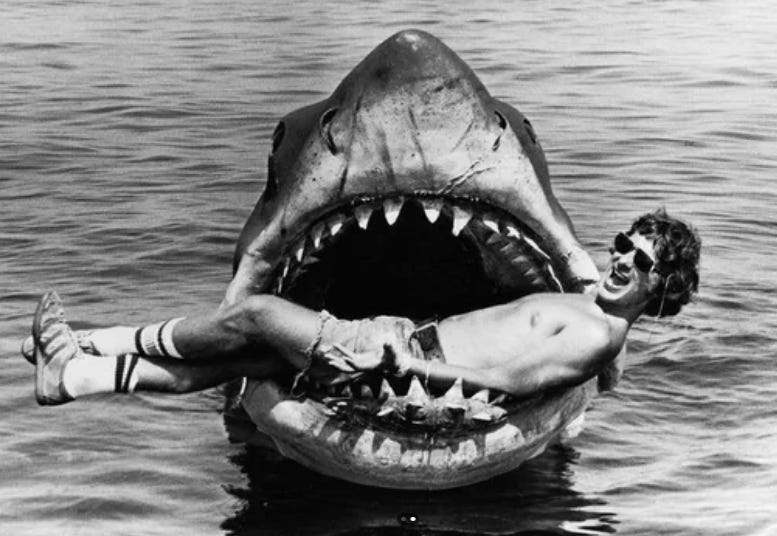
Unlike the typical geezer teaser, the movie was sensational. Only the skill of Spielberg, unknown at the time, turned the movie into a classic.
Fame vs hustle
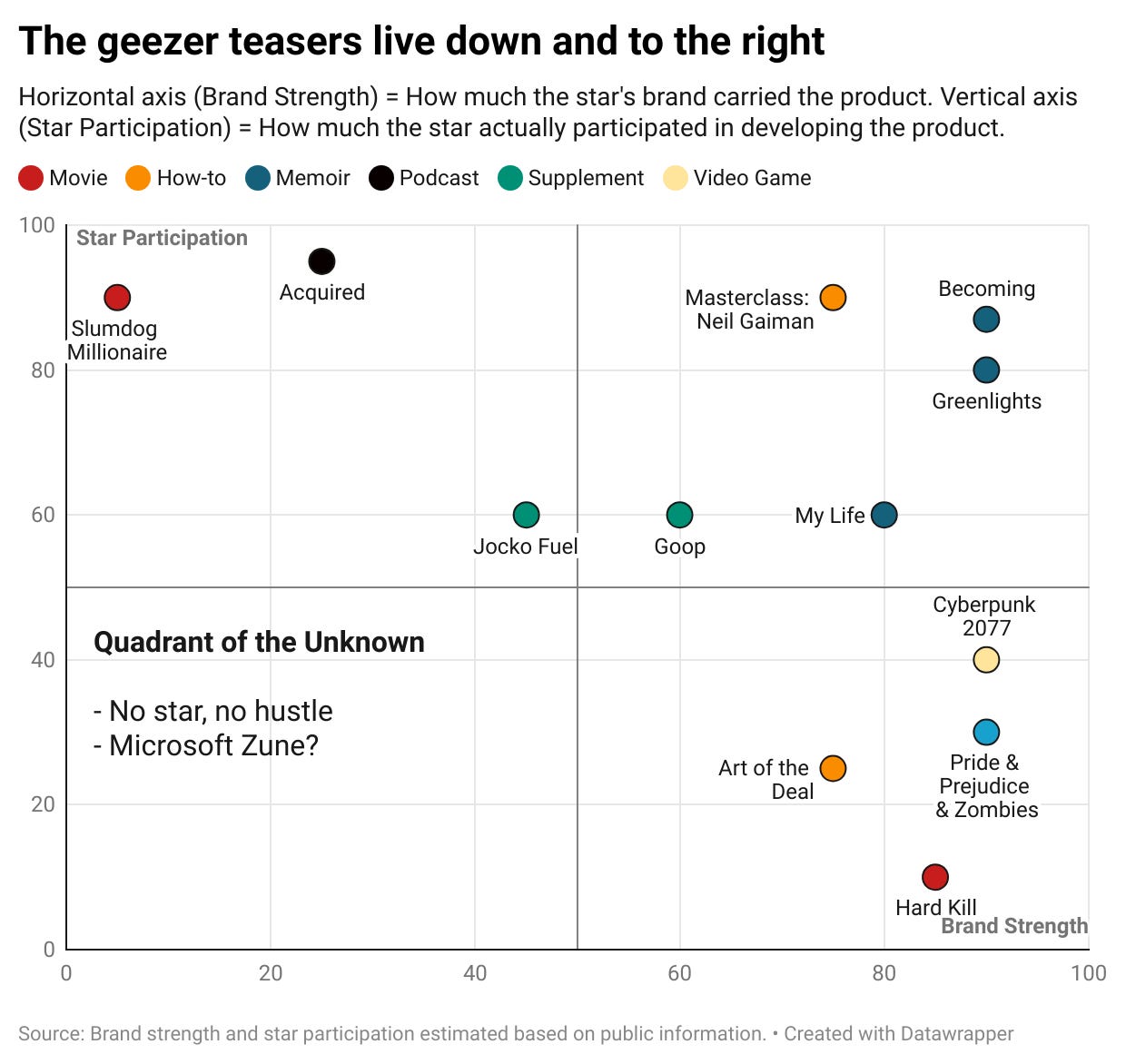
The phrase “geezer teaser” comes from a 2021 article in the online magazine Vulture. Think of it along two dimensions: brand power and star participation.
Brand power is how much the star is used to promote the movie.
Participation is how much the star actually contributes.
Take the Bruce Willis vehicle Hard Kill (2020). The movie runs for 98 minutes. Willis is on-screen for 11. Participation score: 11/98 or 11%. But the real estate Willis takes up in the Hard Kill poster? Almost all of it. Brand power score: 95%.
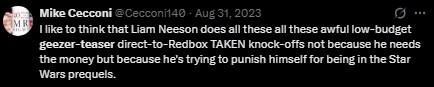
That's the formula. You can apply it to Gwyneth Paltrow's Goop, Donald Trump's Art of the Deal, and Keanu Reeves’s video game voiceovers.
It's not quite a celebrity endorsement. Paltrow, Trump and Reeves have something to do with the product. Just enough to blow up their role, put them on the packaging, and make them far more central than they really are.
The geezer teaser 2x2
My geezer teaser 2x2 uses two dimensions - star participation and brand power - to create a four-quadrant map of products and their creators.
The upper half of the 2x2 has creators who worked their asses off. The difference is whether they were famous enough to carry the brand:
Michelle Obama, Matthew McConaughey, Bill Clinton, Gwyeneth Paltrow and Neil Gaiman all brought star power to their excellent products.
Dev Patel, Jocko Willink, and podcast hosts Ben Gilbert and David Rosenthal all threw themselves into their products, but were relatively unknown. Patel was a nobody, in the movie only due to a fluke. The others were known within narrow circles, but not enough to launch a successful product.
The lower half has those who let others do the work:
On the right, geezer teaser territory: famous, lazy, and well-paid. Donald Trump (for the ghostwritten Art of the Deal). Keanu Reeves in Cyberpunk 2077, a video game for which he did a brief voiceover. Bruce Willis in Hard Kill. Jane Austen did no work on the zombie book - she’s dead, after all - but provided all the star power.
The left is the quadrant of the unknown - “tree falls in the forest” territory. No fame, no hustle. An example might be the Zune. Heralded as the iPod killer, Microsoft all but abandoned the product before it even shipped. Under-resourced, low priority and launched with little conviction, it was doomed from Day One.
The geezer shows the way
In the end, geezer teasers aren’t really about creation. They are about leveraging the old and familiar, which builds a bridge to the new and unfamiliar: Brando to Reeve, Austen to zombies, or Willis to some kid overjoyed to be making his first film.
The geezer’s name is bait. If you take the bait, sometimes it lures you into discovering something better. The big names read their lines and pocket the check, but their shadow may enable someone else to step into the light. The geezers connect the past to the future, the famous old voices to the obscure and talented new ones.
A bloated cameo can open the door to the next generation. Brando’s eight minutes gave us Christopher Reeve. If that’s the price of parsley, maybe it’s not the worst deal ever made at the movies.
Very interesting and very well researched.
Keep them coming.
Nicely done! I’m interested in seeing where you take this.
Best of luck!